

Introducing Border Soundscapes
Updated: Jul 8
Some places are best understood by looking at them.
Others reveal themselves only when we learn to listen.
Border Soundscapes emerged from a desire to explore sound studies through rhetoric and its intersections with philosophical questions about the aesthetics, logic, and ethics of sound. Its open-air laboratory is the U.S.–Mexico border, particularly the sister cities of
Ciudad Juárez, Chihuahua, and El Paso, Texas.
This is a region frequently represented through images.
The border wall.
The desert.
The bridge.
The river.
The line.
These images have shaped how the border is imagined both inside and outside the region.
But what happens when we stop looking at the border for a moment?
What happens when we listen?
Listening to Paso del Norte
The Paso del Norte region has its own acoustic life.
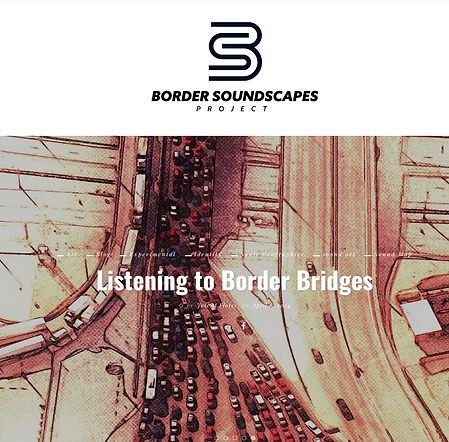
Street vendors move through neighborhoods announcing what they sell. Freight trains cross the city and interrupt conversations. Matachines dance while drums mark the rhythm of devotion. Traffic accumulates along international bridges. Languages meet, separate, and blend. Spanish and English move between voices, radios, streets, homes, and public spaces.
These sounds are not simply background noise.
They tell stories.
Border Soundscapes is an initiative focused on cultural heritage through sound. The project seeks to document, preserve, and reflect on the sounds that characterize the Paso del Norte region, creating a digital platform where recordings can become part of a larger cultural and historical archive.
A sound recorded today may appear ordinary.
Years later, it may become memory.
Decades later, it may become history.
Learning Through Listening
For generations, we have been taught to learn primarily through images and written words.
We read.
We observe.
We analyze what appears before our eyes.
But rarely are we taught how to listen.
Listening is frequently treated as passive. Sound surrounds us, and because it is always present, we learn to ignore much of it. The familiar becomes invisible—or perhaps, more accurately, inaudible.
Border Soundscapes begins with a different assumption: listening is a form of knowledge.
To listen carefully is to notice movement, distance, repetition, interruption, rhythm, and presence. It is to recognize how people inhabit spaces and how spaces become meaningful through everyday acoustic experience.
Every acoustic ecology contains relationships.
Between people and places.
Between memory and sound.
Between bodies and environments.
Between those who produce sound and those who listen.
An Open-Air Laboratory
The border is often described as a line.
For this project, the border is also a listening space.
Ciudad Juárez and El Paso form an interconnected acoustic environment shaped by migration, commerce, transportation, religion, popular culture, language, and everyday life.
The laboratory of Border Soundscapes has no walls.
It is a street.
A market.
A neighborhood.
A bridge.
A plaza.
A train crossing.
A voice moving through the distance.
The project continues to grow as new sounds, stories, and reflections are documented. Its purpose is not simply to collect recordings but to ask what those recordings can teach us about belonging, identity, memory, and sense of place in the borderlands.
Perhaps we already know how the border looks.
Now we need to learn how it sounds.
For more information, visit Border Soundscapes.


Comments